The WineSnark Academy for Sensory Testing, Evaluation & Debauchery (W.A.S.T.E.D.) On Food & Wine Pairing Principles.
Chapter Nine, Parts Two & Three.
 Shortly after WineSnark began its detailed research into taste perception it became apparent that an undertaking of this magnitude required a research team of dedicated, compassionate wine professionals, or as they’re known in the trade, drunks.
And so was born the WineSnark Academy for Sensory Testing, Evaluation and Debauchery (W.A.S.T.E.D.). We WASTED professionals do not take our research sitting down, as getting back up is often difficult, and because thousands of grapes have given their lives to further our understanding of human physiology, biochemistry, sensory perception and stuff.
Read More“Terroir Don’t Mean S_ _ _!”
Chapter Eleven. Part Five.
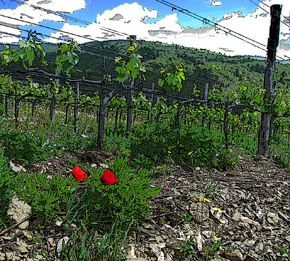 When it comes to the unique “sense of place” that makes wine regions unique, most wine professionals have a tendency to take terroir for granite. But there is one influential wine professional who claims terroir is nothing more than the emperor’s new clothes, a cunning contrivance to keep wine on a pedestal and inflate prices.
Fred Franzia, the man behind Bronco Wine Company, California’s fourth largest winery, is often at odds with those who preach the gospel of terroir, people I call terroirists. In 2010 Franzia wrote on his Facebook page,
Does anybody complicate Cheerios by saying the wheat¹ has to be grown on the side of a mountain and the terroir in North Dakota is better than Kansas and all this horse s- – -?²
Read MoreTerroir; From Great Vines Come Great Wines.
Chapter Eleven. Part Three.
Gerald Asher, A Vineyard in My Glass
 There’s an expression among winemakers that says, “95% of every wine is made in the vineyard.” This simply means that despite the best efforts of man to manipulate wine, its quality ultimately depends on the grapes they start with. Unless of course man takes his 5% and really screws things up, in which case he’ll remind us that 95% of the wine is made in the vineyard. And in case you’re wondering, that’s the vineyard where sour grapes come from.
It Was The Best Of Wines. It Was The Worst Of Wines.
Chapter Eleven. Parts One & Two.
The November 1997 issue of the Wine Spectator rated the Louis Latour 1990 Corton-Charlemagne 98 points … and 88 points.
98 LOUIS LATOUR Corton-Charlemagne 1990
Exotic, wild and savage. A deep, “gonzo-crazy” terroir wine, full-bodied and packed with dried herbs, honey and spicy oak. Almost tannic in structure, it explodes like a small volcano on the palate for an unbelievable experience. Not for the faint of heart though.
88 LOUIS LATOUR Corton-Charlemagne 1990
Mature, with an herbal, slightly leathery accent to the pear and oak flavors. Shows its age via dryness and coarseness on the finish.
In the same issue the 1995 Arrowood Réserve Spéciale received 95 points … and 82 points, and the Rochioli 1995 Allen Vineyard Reserve was awarded 96 points … and 85 points. These dyslexic point spreads were not the result of ADD (Alcohol Drinking Disorder); these Dickensian observations were simply a tale of two critics.
Read MoreMetaphors In Wine Journalism.
Chapter Six, Part Three.
 Are you feeling some trepidation about your ability to accurately evaluate and describe wine? Relax. Wine analysis isn’t black arts or brain surgery … It’s rocket science. Hey, I’m kidding. Describing wine is easy. All you need is a steady stream of euphemisms, metaphors and dialysis treatments.
If you’ve been following these pages you should now be adept at euphemisms and similes so it’s time to let the right brain step up to the plate and take a swing at metaphors. Wine writers use a truckload of metaphors, or maybe it’s a ton of metaphors … no, it’s a sea of … you get the idea, we use lots of metaphors.
Read More