There’s No Accounting For Taste.
Chapter Two, Part Four.
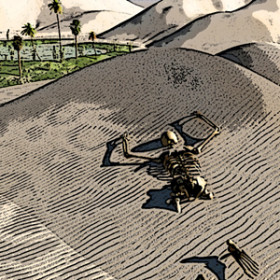 Imagine you’re sitting at a desert resort when you spot a man dragging his haggard body across the sand. The tattered remains of his clothes cling to his emaciated body. His face is covered by a week-old beard. He looks up at you pleadingly.
“Good Lord man!” you cry. “You must be thirsty. Here, have some wine!”
In a raspy voice he croaks, “How many points did it score?”
Now I don’t want to get off on a rant about the wine rating system, but have you ever noticed that a wine that tastes great to The Wine Spectator or The Wine Advocate doesn’t always taste so great to you?
Read MoreRussian River Delivers Outstanding Chardonnay.
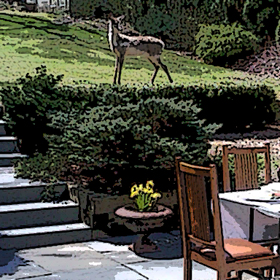
Our first outdoor dinner of the season was shared with some deer friends.
Inspired by the season’s first dinner on the patio (which marks the official T-time for white wine drinking) I thought I’d put down in print my take on many of the outstanding Russian River and Sonoma Coast Chardonnays I’ve encountered at the recent round of wine tastings.
This time around I was pounding the pavement at two outstanding events in Manhattan, one entitled “Taste of Sonoma; On Tour” hosted by an assortment of Sonoma Valley trade organizations and the other presented by wine distributor extraordinaire Michael Skurnik Wines.
Tasting season is a demanding time for the wine makers, winery owners and the assorted experts that pour wine at these events.
Read MoreThe Nose Knows.
Chapter Two, Part Two.
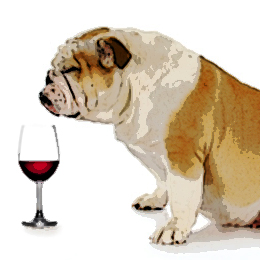 The most revealing aspect of wine analysis comes from olfaction, the sense of smell. Odorants are sensed by olfactory receptor neurons in the nose, or as they’re more commonly called, smell buds. O.K., I just made that up. They’re not really called smell buds, but it’s my blog and I’ll call them whatever I want. Besides, olfactory receptor neuron sounds like some kind of hi-tech weapon used to deduce wines complex aromas, you know, one of those weapons of mass deduction.
Humans possess about 40 million smell buds. To put that in perspective your average dog has about 68 billion smell buds, yet oddly enough there are only a couple of dogs writing for The Wine Spectator.
Read MoreThe Wine Listener.
Chapter Two, Part One.
 Before I get to the obligatory blog about how to taste wine, I’d like to explain how you taste wine. You’re probably thinking, “It sounds like this guy has already tasted enough wine for one night” (and you’re absolutely right).
What I’m trying to say is there are tasting-techniques to enhance your perceptions of wine, and in the next chapter I’ll explain how to use these procedures. This chapter will explore how your senses perceive aromas and flavors, or how you taste wine from a physiological point of view. Throughout this blog I’ve put in my five cents; this is where you pony up your five sense.
Read MoreChange Comes Slowly To Bordeaux
Chapter Sixteen, Part One.
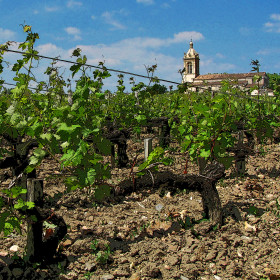 On the right bank of the Gironde River in the heart of Bordeaux, and just a short bicycle ride from the medieval village of St. Emilion, sits the family run Chateau Cantenac. My wife Caroline and I dismount and receive a warm greeting from the matriarch-owner of the estate, Nicole Roskam-Brunot and her son Johan. Strolling through vineyards first planted by his great grandfather, Johan remarks, “Change comes slowly to these vineyards. Twenty years is a very short time in St. Emilion.”