Similes In Wine Journalism Are Like ‘Totally Awesome’.
Chapter Six, Part Two.
 Americans often have difficulty with the vocabulary of wine analysis, which is odd as we seem to have no problem talking about our “feelings”. We’ve become so sensitive that I often well up with tears just watching a Hallmark commercial and something really emotional can send me to bed for a week, say something like picking up the check.
When it comes to describing wine our vocabulary is often limited to “I like it” or “I don’t”. The French on the other hand, have no difficulty when it comes to expressing their feelings about wine. Perhaps that’s because the language of wine is much like the language of love; it’s euphemistic, metaphoric, similecious, and pornographic.
Read MoreThe Umami Tsunami.
Chapter Eight, Part Three.
One + One = Three (The Synergy Of Umami).
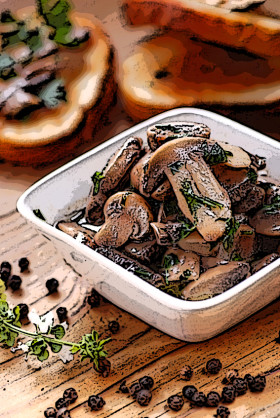 The subtle, savory fifth taste known as umami was first identified by Japanese scientist Kikunae Ikeda in 1907. In researching umami he discovered that it was linked with the amino acid glutamate and his investigations led to the development of monosodium glutamate (MSG) as a flavor enhancer. I could feed you lots of material about the development of umami-rich MSG but you would just be hungry for more in an hour.
The umami tsunami began in earnest six years after Ikeda’s discovery when his follower Shintaro Kodama learned that glutamate, when combined with nucleotides, creates a dramatic flavor enhancing synergy. For example, when meat (high in the nucleotide inosinate) is combined with glutamate-rich foods like tomatoes or cheese, a significant umami boost is created. To understand the power of this synergy, think of the flattering outcome when you add cheese to a hamburger or braciola to tomato sauce (or as we say in New Jersey, you put the bruh-johl in the gravy).
Read MoreOf Esters & MLFs.
Chapter Twelve. Parts Three & Four.
The Ester Ouster
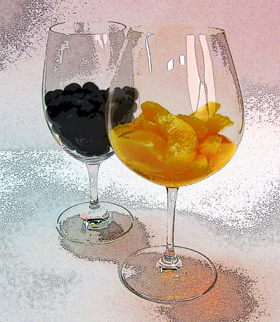 So what makes Cabernet Sauvignon smell like black currants and Viognier smell like peaches? The answer is only skin-deep – much like Jessica Simpson’s appeal or an outbreak of shingles.
The cellular make-up of grape skins hold barely detectable aromatic compounds that are magnified during fermentation. Without fermentation these compounds would remain trapped inside the grape skins and then this would be a boring blog about grapes that no one will read … as opposed to a boring blog about wine that no one will read.
The cellular make-up of different grape varieties translates into aromas that are unique to that variety. During fermentation these compounds interact with yeast, alcohol and acids to create flavor substances known as esters. These esters also develop and evolve after fermentation, as chemical reactions continue to take place as wine ages. I also continue to develop new chemical reactions as I age but I control them with Depends.
Read MoreThe Best Of WineSnark 2014.
One Day You’ll Look Back At This And It Will All Seem Funny – I Hope.
 January marks the official start of the “BEST OF” season. Wine publications have already released their TOP 100 WINES OF THE YEAR, strategically unveiled just before the drinking playoffs (also known as the holidays). Soon newsstands will be overflowing with trendy magazines flaunting the SEXIEST MEN & WOMEN OF 2014, the TOP 100 SELFIES OF 2014, or THE TOP 100 STUPIDEST TOP 100 LISTS OF 2014.
In an effort to remain trendy, sexy and stupid, WineSnark has created its own BEST OF 2014 list. I tried to create a TOP 100 list but I dozed off at 30 so that’s where I left it. So here are 30 of the snarkiest comments culled from the pages of this august institution and very precisely presented in absolutely no particular order.
Read MoreWho Put The Bop In The Bop Shoo-Bop Shoo-Bop?
or “Where Do All Those Wonderful Flavors Come From!”
Chapter Ten. Part One.
 Regular followers of WineSnark have learned how to discern and describe the varied vagaries of vino but have you ever wondered where these peculiarities come from? Why does Syrah from the Rhone Valley taste different from Shiraz produced in Australia? (Syrah and Shiraz are the same grape variety but our spell buds perceive them differently). Where does the “butter” flavor come from in some Chardonnays? How come Cabernet Sauvignon can taste like blackberries or like vanilla? What makes Pinot Noir taste different from Pinot Gris?
The answer to these questions can be found in the science of winemaking. Now don’t roll your eyes and reach for the mouse. I realize the onus of this site is flavor and not geography, meteorology, botany or chemistry, but this stuff has everything to do with the quality of wine and it’s about time WineSnark examine the scientific foundation of these unique flavors. I promise to keep it simple and I won’t even use a periodic table, unless I need someplace to set my wine glass.
Read More