A Stroll Through History On The Roman Road To St.-Emilion
Chapter Sixteen. Part Six.
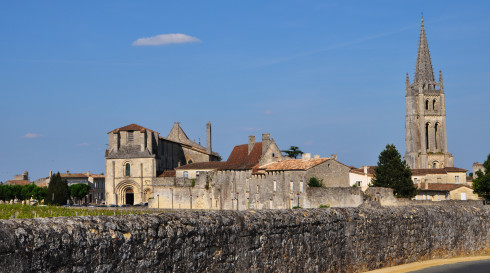 The wines of Bordeaux were my first oenological love, a passion I’ve shared with my wife Caroline for over thirty years. To rekindle our premier amour we visited Bordeaux and like the forgotten vignerons, monks and armies before us, we hiked an ancient Roman Road through historic vineyards to get to the higher place known as St.-Emilion.
The Roman Road, built to service a triumphant empire 2000 years ago, is now protected from development and allows travelers to walk through Bordeaux vineyards first planted in the 2nd century. As it passes through the vineyards of Chateau Franc-Mayne it is little more than a path strewn with broken cobblestones, sloping gently upward as if propelling you to a higher purpose. This seems somehow fitting as the road leads to the medieval village named for the Friar Emilion, a reclusive 8th century monk who achieved sainthood
Read MoreCh Ch Ch Changes to the 1855 Bordeaux Wine Classification
Chapter Sixteen, Part Four.
“Every time I thought I’d got it made, it seemed the taste was not so sweet.” David Bowie
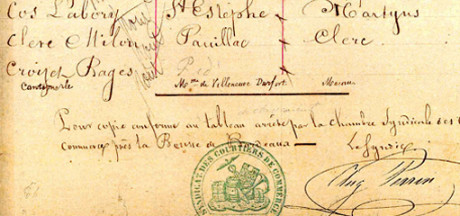 The authors of the Official Bordeaux Wine Classification made an unusual entry on the original handwritten document drawn up in 1855. Cantemerle (now known as Chateau Cantemerle) appears to have been written on the bottom of the historic list in a different hand than the other entries. It is squeezed into a narrow space below the Fifth Growth ranked Croizet-Bages (formerly the bottommost entry) and looks like an afterthought on the part of the authors. Cantemerle was also left off the map of estates that was displayed at the 1855 exposition, although it has appeared on every subsequent map since 1856.
A Look At French Wine Laws
Chapter Sixteen, Part Two.
 France has hundreds of wine appellations that are broken down into three quality levels; Appellation d’Origine Contrôlée (AC or AOC), Vin de Pays (VdP), and Vin de Table (VdT). These designations are controlled by the Minister of Agriculture, under the auspices of the Institut National de l’Origine et de la Qualité. Rather than adopt the logical acronym INOQ, the organization retained an earlier acronym INAO (for Institut National des Appellations d’Origine) so they wouldn’t have to replace the stationary.
When it Comes to Wood, Size Matters
Chapter Thirteen, Parts Three, Seven & Eight.
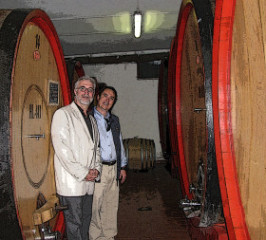
Surrounded by botti with Filippo Fedriani at Marchesato degli Aleramici in Montalcino.
Different wine regions use barrels of varying size to fit their needs (and maybe their warehouses). The volume of the popular Hogshead barrel seems to vary with every industry, but for wine it has come to mean a 63-gallon barrel, while the uniquely named butt barrel holds two Hogsheads or 126 gallons. The winemakers of Bordeaux find a barrel holding 59.4 gallons is perfectly suited for Cabernet and Merlot based wines. In Montalcino, where tradition dictates that Brunello di Montalcino be aged in cask for three years, wine is matured in large Slovenian casks called botte, or the plural botti, a term presumably derived from butt (those are 6 words I never imagined myself writing). Smaller barrels have a stronger impact on wine, so most Brunello producers use botti because they feel three years aging in small casks would produce overpowering oak flavors in the finished product.
The Salt Conundrum In Food & Wine Pairing.
Chapter Nine, Part Eight.
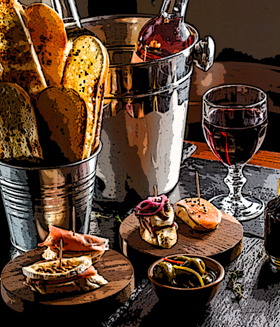 When pairing food with wine, sweet and sour tastes fall neatly into the cancellation category, bitter and piquant are subject to the cumulative effect, and umami is best grouped with neutral pairings, but what about salt? In moderation, salt doesn’t seem to have any conspicuous consequence, but how does excessive saltiness in food affect the taste of wine? To learn how (or if) salt fits into the A. cancellation, B. cumulative or C. neutral categories, I invited some friends over for some organoleptic research. They quickly declined until I told them that meant we were going to eat and drink wine.
Good old fashioned research is difficult and time consuming but in the name of conscientious reporting the WASTED team (Wine Snark Academy for Sensory Testing, Evaluation & Debauchery) created a salty feast and drank five bottles of wine because that’s the kind sacrifice we’re willing to make in the name of, umm … science, yeah that’s it, science.
Read More